 Wannatype Blog
How to Journal When You Don't Know What to Write: Start With Three Lines
Stuck on what to write in your journal? Write one line of fact, one line of feeling words and one line for tomorrow's action.
If you don't know what to put in your journal, write just one line about something that happened today, one line of words for how it felt, and one line about an action to try tomorrow. Once you let go of trying to write well, it takes about five minutes, and the third line becomes a bridge into the next day. Below, we look at what to write on each line, with examples.
Why does writing about the day keep slipping?
When you open a blank notebook, it is easy to get stuck at "What even happened today?" If you try to sum up the whole day, there is either too much to write or, the other way round, nothing seems special enough.
That is why it can help to decide the slots before the length. Once the slots are set, "What should I write?" shrinks to "What goes in this slot?"
Split your journal into three lines like this
Hannah, a fictional person, kept stopping at the first sentence and closing the notebook. Then she gave each line its own job.
- Line one · one fact: "I didn't share my opinion in the meeting."
- Line two · feeling words: "Regret, tension, tiredness."
- Line three · one action for tomorrow: "In tomorrow's meeting, I'll ask one question first."
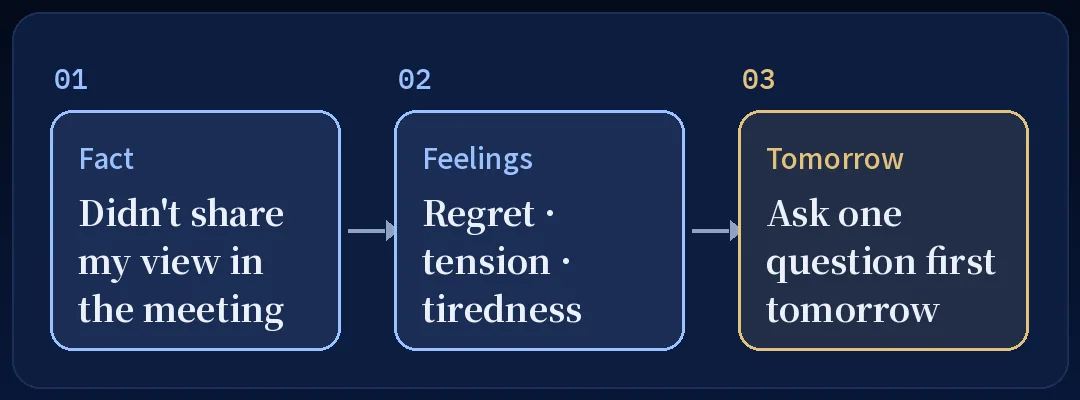
On line one, write only the fact, with no interpretation. "I didn't share my opinion" makes the next action easier to picture than "I'm a passive person."
Name the feeling with three words
If line two feels hard, skip "good" or "bad" and pick narrower words, such as regret, relief or hurt. Putting feelings into words is called affect labeling. The English Wikipedia article on it describes research suggesting it is also used in journaling and may ease the weight of a feeling, while noting that more research is still needed.
Marcus, a fictional person, at first only had one word: "tired." After about a week, he began writing that "tired" also held "bored" and "impatient."
Words you can use today"Today, when ____, I felt ____, ____ and ____."
Point the last line toward who you want to be
Line three is not an apology letter; it is tomorrow's first step. If you end with "I was pathetic for not speaking up," the day stops there. If you end with "Tomorrow I'll ask one question first," it carries into tomorrow.
Here, think for a moment about the person you want to be. Hannah wanted to be "someone who sorts out her thoughts and speaks calmly," so on line three she wrote "Write one note before speaking."
Wannatype's missions include journaling too
Wannatype tests "who I am now" and "who I want to be" twice with the same questions and shows how much they overlap as a Sync score. Based on that gap, it suggests three missions a day, and the app really does include missions similar to today's post.
- Energy axis, Introvert (I) Lv.2 mission: "Write five lines about how today felt"
- Decisions axis, Feeling (F) Lv.3 mission: "Name today's feelings in three words and why"
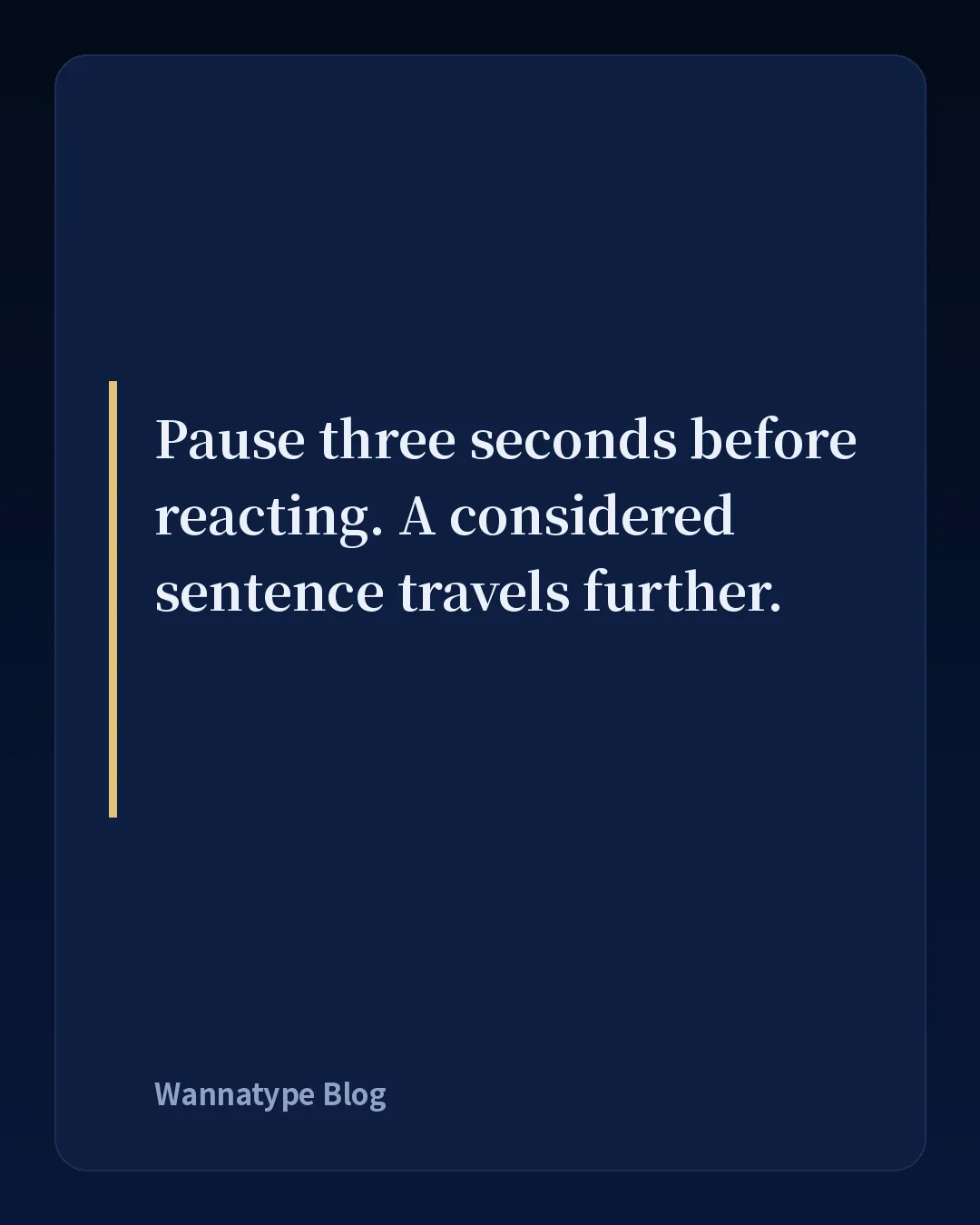
- What coach Ideal says toward the Introvert (I) side: "Pause three seconds before reacting. A considered sentence travels further."
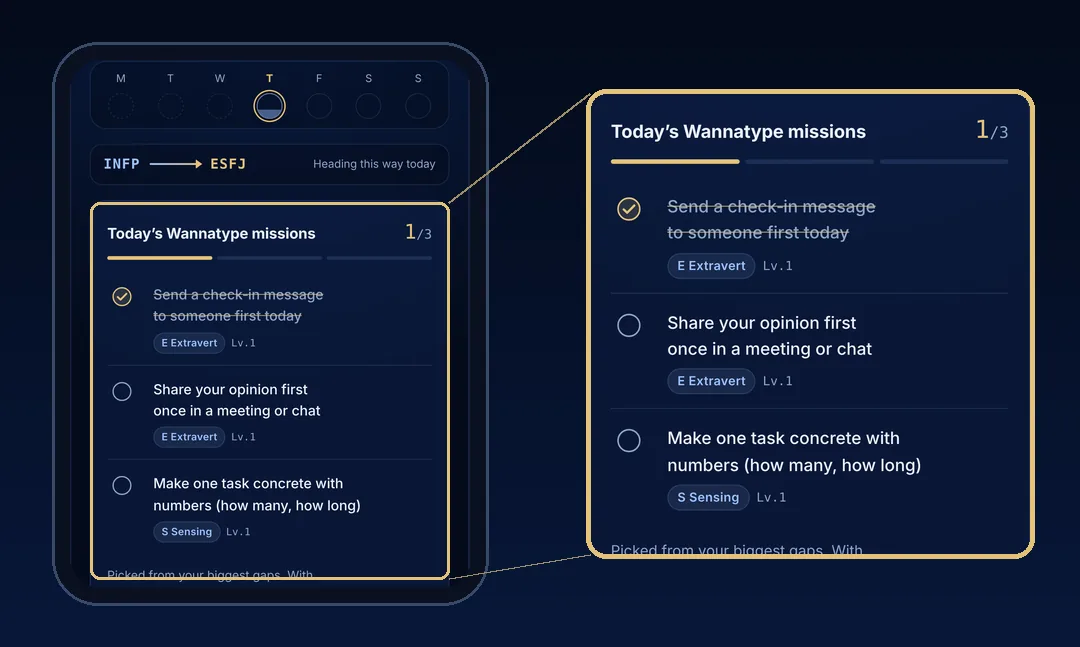
The screen content is an example, and which missions you get depends on the results of your two tests. The app's results may differ from other tests. Once three lines feel familiar, you can stretch to the five-line mission.
Keep reading
 1 HOURSelf-actualization
Self-Actualization Feels Out of Reach? Live One Hour of Your Future Day
When self-actualization feels vague, write out an ordinary day one year from now, hour by hour, and live just one hour of it this week. Three simple steps.
 1 SCENEPersonality
Don't Like Your Personality? Pick One Scene Instead of Changing It All
When you don't like your personality, turn "I'm just like that" into one scene and one action, and keep the strengths you already have.