 Wannatype Blog
Don't Like Your Personality? Pick One Scene Instead of Changing It All
When you don't like your personality, turn "I'm just like that" into one scene and one action, and keep the strengths you already have.
When you don't like your personality, instead of trying to change all of it, take one sentence like "I'm just that kind of person" and turn it into one scene and one action. You keep the strengths you already have and move just one behavior toward who you want to be. Below, the method is laid out in three steps.
Personality shows up as behavior you repeat
The Korean Wikipedia article on personality describes it as a person's distinctive psychological system that shows particular patterns of behavior toward their environment, and keeps and develops them. That sounds abstract, but what you can actually see is someone moving in similar ways in similar scenes.
So when you stick a big label on yourself, like "I'm timid," it's hard to see where to begin. If you break it into scenes instead, such as "I swallow my opinion in meetings" or "I say yes the moment someone asks," at least one of them is something you can do differently today.
1. Break "I'm just like that" into scenes
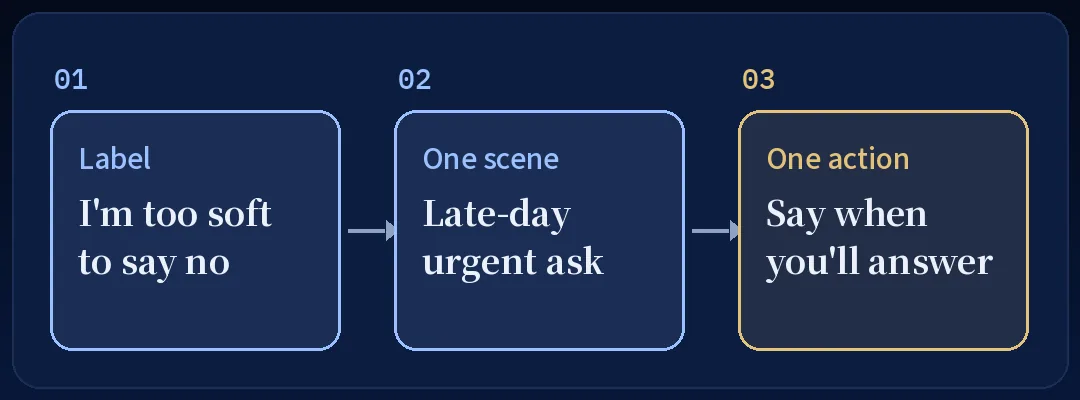
Hannah, a fictional person, often said, "I'm too soft to say no." When she wrote it down, she noticed the hardest moments were almost always 30 minutes before the end of the workday, when a coworker asked for urgent help.
Once she saw a scene instead of a label, the task got smaller. Not "become someone who says no well," but just "don't answer a late-day request on the spot."
2. Choose one action for that scene
A good action can be finished within a day, and you can tell for yourself whether you did it. Hannah chose one step toward the Thinking (T) side of the Decisions axis. Among Wannatype's Thinking (T) Lv.2 missions there is also "Decline one request politely but clearly."
If saying no right away feels too hard, you can start by changing how you put off the answer. Putting your usual reply next to the one you could try makes the difference easy to see.
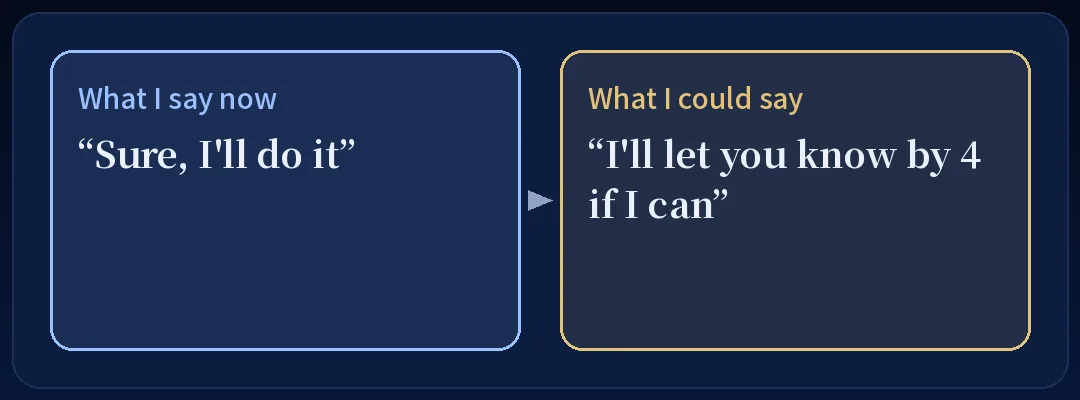
The next day, when she got the same kind of request, Hannah used the sentence below word for word. She did end up taking on the task, but she said she got to decide for herself when she could have it done.
Words you can use today"I can't answer right away, but I'll let you know by 4 whether I can do it."
3. Keep the strengths you have now
Changing one behavior doesn't mean the current you is wrong. Part of why Hannah found it hard to say no was that she thinks about other people's situations first.
The Wannatype result screen has a section called "Keep these strengths." On the Feeling (F) side you might see "warmth that reads people," and on the Introvert (I) side "deep thinking and long focus." Hannah kept that warmth and added "I know it's urgent" before her answer.
Daniel, a fictional person, tends to be quiet and usually just listens in meetings. He kept his ability to think deeply and changed only one thing: asking a question first before the meeting ends. Coach Ideal says this toward the Extravert (E) side: "Say the first word. It doesn't need to be perfect — “Here's what I think…” is enough."
See yourself on four axes in Wannatype
Wannatype tests "who you are now" and "who you want to be" twice with the same questions and shows how much they overlap as a Sync score. It looks at where the gap is biggest across the four axes of Energy, Perception, Decisions and Lifestyle, and gives you three missions a day to match.
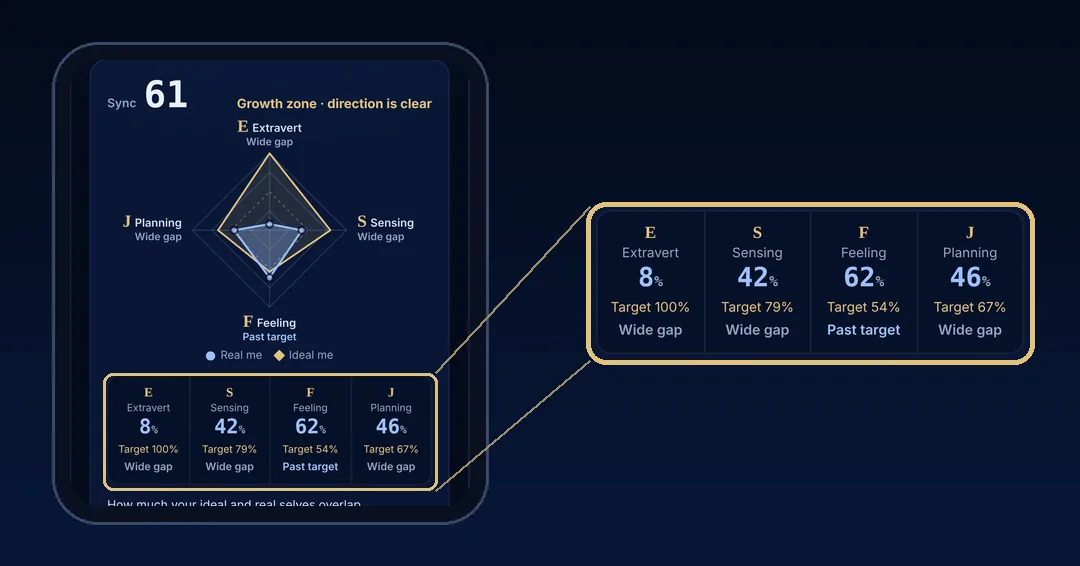
What you see on the screen is an example, and the missions you get depend on the results of your two tests. Results in the app may differ from other tests. The 16 personality tendencies are a frame for looking at tendencies, so they don't explain everything about a person.
Keep reading
 1 HOURSelf-actualization
Self-Actualization Feels Out of Reach? Live One Hour of Your Future Day
When self-actualization feels vague, write out an ordinary day one year from now, hour by hour, and live just one hour of it this week. Three simple steps.
 10 MINStress
Stress Relief: First Choose Between Talking It Out and Sorting It Out Alone
When stress relief lists don't click, first choose whether to talk it out or sort it out alone, then start with one 10-minute thing.